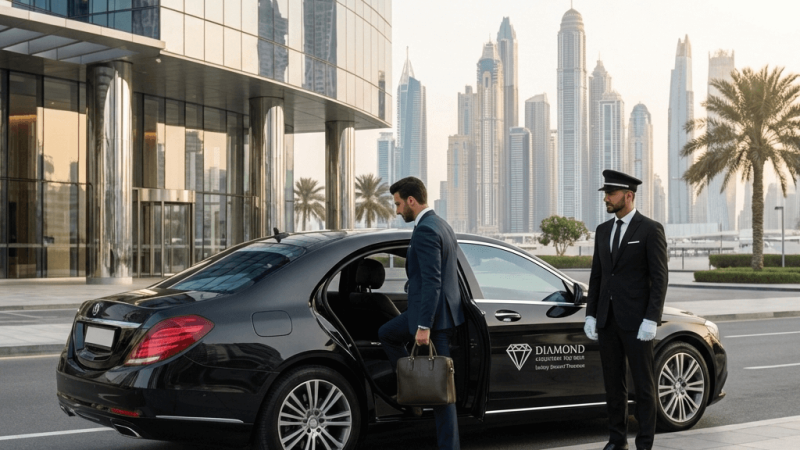
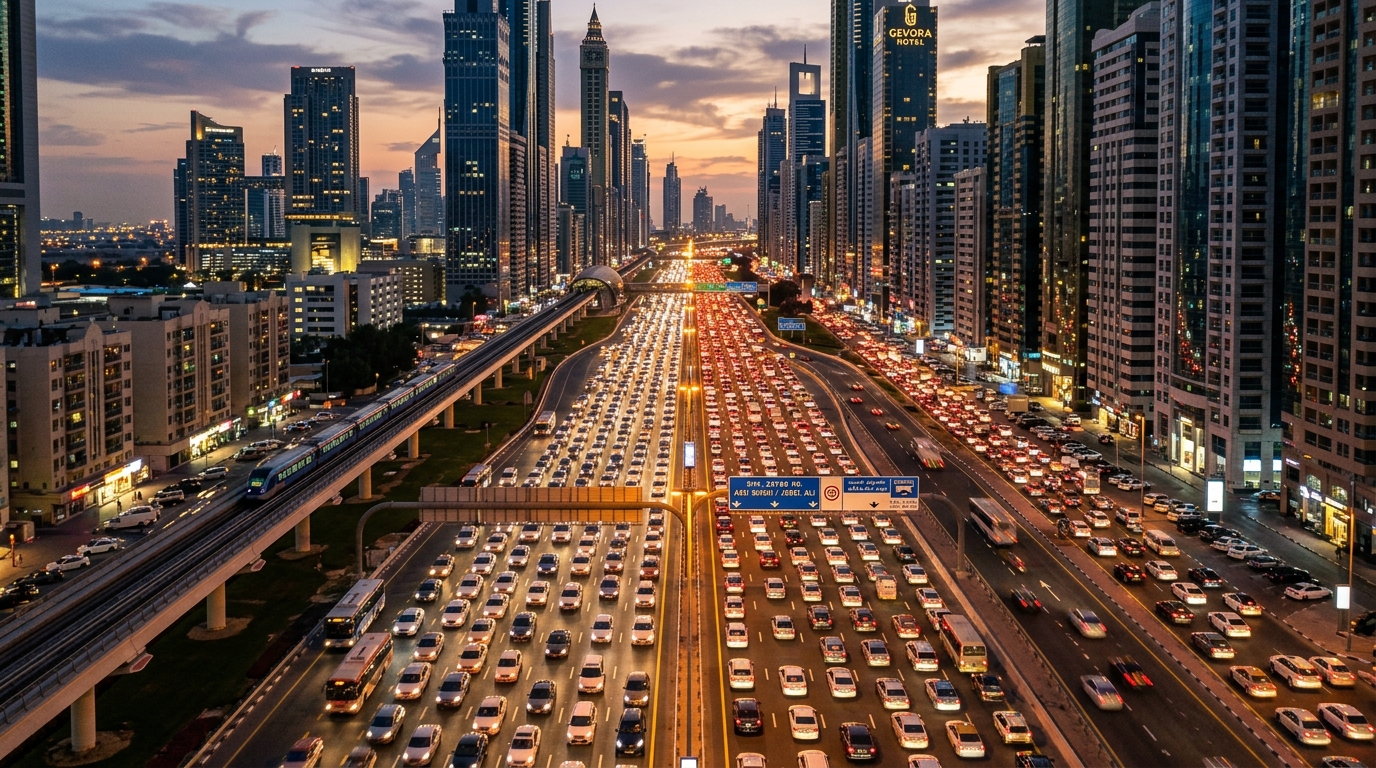
Dubai’s traffic follows a pattern you can plan around. Weekday mornings back up from roughly 7:00 to 9:30am, evenings from 5:00 to 8:00pm, and Sheikh Zayed Road carries the worst of it — over 400,000 vehicles a day, with the Marina-to-DIFC stretch the slowest link in the chain. Knowing that pattern helps. Having a driver who plans around it before you even ask helps more. Here’s what the pattern actually looks like, and where a chauffeur genuinely changes the outcome versus where a traffic app alone gets you most of the way there.
Key Takeaways
- Dubai’s daily traffic peaks fall roughly 7:00-9:30am and 5:00-8:00pm on weekdays, with evenings usually worse than mornings.
- Sheikh Zayed Road (E11) is the city’s worst corridor, especially between Dubai Marina and DIFC; Al Khail Road (E44) is the main relief route.
- A chauffeur doesn’t make traffic disappear — the real value is route knowledge and real-time rerouting handled before you have to think about it, plus a fixed pickup time that doesn’t slip when the road does.
- Diamond Chauffeur Tourism’s drivers operate under RTA licensing and plan routes around live conditions as standard, not as an add-on.
When Is Dubai Traffic Actually Worst?
Weekday mornings run heavy from about 7:00 to 9:30am as the city heads to work and school. The evening peak, roughly 5:00 to 8:00pm, is usually the tougher one — office traffic, school pickups, and early leisure trips all land on the road at the same time, where the morning peak is mostly just commuters.
Thursday afternoons behave differently: traffic builds from around 4:00pm as the week’s “mini-weekend” starts early, particularly toward Marina and Downtown. Weekends flip the pattern entirely — the roads themselves are quieter early, but malls, beaches, and tourist hubs get busy from mid-morning through the evening. If you’re doing a weekend errand run or an early tour departure, before 9:00am is consistently the clearest window.
None of this is a guarantee — a single accident or a closed lane can override a normally quiet hour. It’s a pattern worth planning around, not a schedule you can set your watch to.
Dubai’s Worst Roads and Traffic Hotspots
Sheikh Zayed Road (E11) carries more traffic than any other road in the city — over 400,000 vehicles daily, with peak-hour flow reported between roughly 14,000 and 35,000 vehicles an hour. The worst stretch runs between Dubai Marina and DIFC, slowing most heavily northbound toward Downtown and Business Bay during the morning peak, and the reverse direction in the evening.
Al Khail Road (E44) is the main alternative running parallel to Sheikh Zayed Road. Following a 2024-2025 RTA improvement project, it now handles up to 19,600 vehicles per hour at key intersections, cutting travel time on that corridor by around 30% — a genuinely useful relief route, though it compresses again near the Business Bay bridges and Meydan merges during peak hours.
Beyond the two main arteries, a handful of districts stay congested through most of the day regardless of the corridor feeding them: Downtown Dubai, Dubai Marina/JBR, and Business Bay, all popular enough with residents and visitors alike that traffic there rarely fully clears.
| Road / area | Worst window | Notes |
| Sheikh Zayed Road (E11) | 7:00-9:30am northbound, 5:00-8:00pm southbound | Marina-to-DIFC stretch is the slowest link |
| Al Khail Road (E44) | Compresses during both peaks | Best relief route, but bridges/merges near Business Bay bottleneck |
| Downtown Dubai / Business Bay | Most of the working day | Consistently busy independent of the main-road peak |
| Dubai Marina / JBR | Evenings and weekends | Leisure and dining traffic layers on top of commuter flow |
How a Private Chauffeur Actually Beats the Traffic
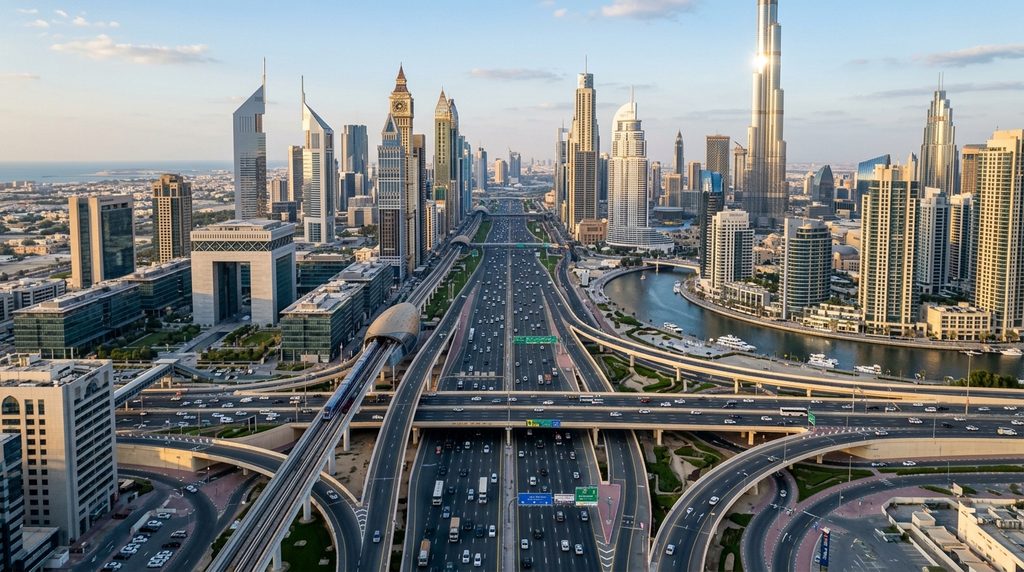
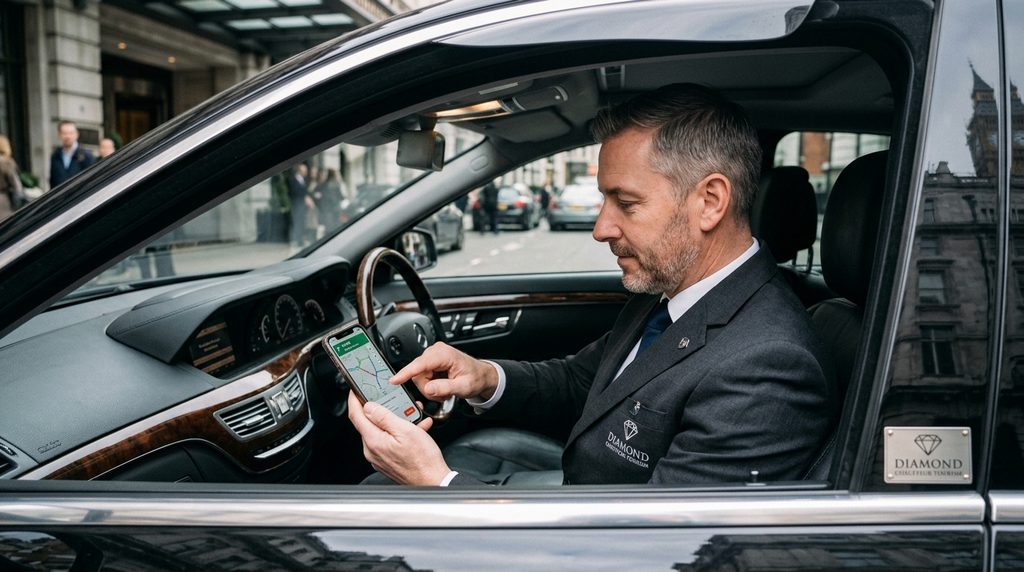
A navigation app and a chauffeur start from the same place — both watch live conditions on Google Maps, Waze, and the RTA Dubai app. The difference shows up in what happens next. An app tells you a road is slow; a driver who works these roads daily already has a short list of parallel routes and side streets that a first-time app user wouldn’t think to search for, and picks between them before the delay compounds.
The second difference is timing. A chauffeur builds your departure around your actual appointment, not a rough guess — leaving earlier for a meeting that can’t run late, or later for a flexible dinner reservation, based on what the roads are doing that specific hour rather than a fixed rule of thumb.
And the third is simply what you’re doing while it happens: working, on a call, or resting, instead of watching the lane next to you creep forward.
Diamond Chauffeur Tourism’s approach
Diamond Chauffeur Tourism’s drivers are RTA-licensed and plan routes around live traffic conditions as a standard part of every trip — not something you have to request.
Special Cases: Events, Ramadan, and Peak Season
A handful of periods push travel times well past the normal daily pattern.
Major events — conferences, concerts, large gatherings near Downtown or the Dubai World Trade Centre — can add significant delay to the surrounding roads, sometimes doubling a normally short trip on event days.
Ramadan shifts the daily pattern rather than just intensifying it: the roughest window is the hour or two before sunset as people rush to reach iftar, with clearer roads early in the morning (before 8:00am), through midday (roughly 10:00am-2:00pm), and again after iftar settles (around 8:30-9:00pm).
Peak tourist season (roughly December through March) adds hotel check-in surges and heavier airport-adjacent traffic on top of the usual commuter pattern, particularly around Sheikh Zayed Road and Downtown.
If your trip falls inside any of these windows, treat the standard rush-hour estimates as a floor, not a ceiling — and build in extra buffer accordingly.
If You’re Driving Yourself: Quick Tips
Not every trip calls for booking a chauffeur, and the same route knowledge applies whether you’re behind the wheel or not:
- Use Al Khail Road as relief when Sheikh Zayed Road is backed up, where the route makes sense for your destination.
- Check the RTA Dubai app or Google Maps before you leave, not just once you’re already stuck.
- Build in a 15-20 minute buffer around the known peak windows above — it’s usually enough to absorb a normal delay without changing your whole schedule.
- Avoid Deira and Karama specifically during peak hours; both hold traffic longer than the main arteries around them.
Is It Worth Hiring a Chauffeur Just to Avoid Traffic?
It depends on how often you’re making the trip and what your time is worth while you’re in the car. It tends to make the most sense for:
- Business travelers stacking back-to-back meetings across the city, where a missed window has a real cost.
- Visitors unfamiliar with the road network, who’d otherwise lose time to wrong turns on top of the traffic itself.
- Anyone making the same commute regularly — a standing or monthly chauffeur arrangement often works out more predictable than day-to-day driving.
- Airport transfers during peak arrival windows, where a fixed pickup time matters more than almost anywhere else — see our Dubai Airport to Downtown Dubai guide for how that specific trip breaks down.
Why Book Diamond Chauffeur Tourism
The promise is simple: RTA-licensed drivers who plan around Dubai’s traffic before you ask them to, not after you’re already stuck in it. Every booking includes route planning built around live conditions and real-time adjustment if something changes mid-trip — at no extra charge if traffic, not you, is the reason a trip runs long.
Frequently Asked Questions
Weekdays, roughly 7:00-9:30am and 5:00-8:00pm, with the evening window usually worse. Thursday afternoons often start early, from around 4:00pm.
Sheikh Zayed Road, especially between Dubai Marina and DIFC, is the worst corridor. Al Khail Road is the main alternative but compresses near Business Bay during peak hours. Downtown Dubai, Marina/JBR, and Business Bay stay busy through most of the day regardless of the main-road peak.
It doesn’t make traffic disappear, but it removes two real costs: the time lost picking a route on the fly, and the uncertainty of not knowing exactly when you’ll arrive. A driver who works these roads daily already knows the alternatives and times your departure around your actual schedule.
Yes, but differently — the roads themselves are quieter early, while malls, beaches, and tourist hubs get busy from mid-morning onward. Before 9:00am is usually the clearest window for weekend trips.
Conclusion
Dubai’s traffic is predictable enough to plan around: two daily peaks, one dominant corridor, and a handful of districts that stay busy regardless of the time. What a chauffeur changes isn’t the traffic itself — it’s the route knowledge and timing that turn a predictable pattern into a predictable arrival. For a trip where that certainty matters, that’s exactly what Diamond Chauffeur Tourism’s RTA-licensed drivers are set up to handle.